
The Lantern on Dusty Hill
The complete 40-page illustrated Rugged Grace story.
Less screen time. More family face time.
We're delighted you're here! Come inside, explore Zeke's Corner, visit the Parents' Room, browse the Trading Post, and enjoy a free family story.
December 4, 2026 — Founders memberships open at $7.99/month.
December 7, 2026 — Our first official weekly story, The Empty Chair, arrives for eligible members.
Grace First. Truth Always. Hope Remains.
Opening Rugged Grace...
The complete 40-page illustrated Rugged Grace story.

For Parents

Parent Resource Shelf
Helping Your Child Feel Safe Enough to Talk
The Rugged Grace Parent Resource Shelf
A family resource from Parson Country Media
"How was school?"
"Fine."
"Anything bothering you?"
"No."
Sometimes you wonder what happened to the child who once couldn't wait to tell you everything.
But a quiet child isn't necessarily a distant child. Children sometimes need time to understand their feelings before sharing them.
The important thing isn't finding the perfect question. It's creating a relationship where conversations feel safe.
Some of the best conversations happen when nobody is trying to have one.
Washing dishes, walking the dog, or sitting together after supper can provide opportunities for children to open up.
Instead of asking question after question, simply enjoy being together.
Don't feel obligated to fill every silence.
Sometimes your presence says more than your questions.
When your child finally shares something difficult, resist the urge to immediately solve the problem.
Listen first.
Try saying:
Children need to know their feelings matter, even when we don't agree with their decisions.
Listening doesn't mean abandoning discipline or responsibility.
It means making room for understanding before correction.
Children learn whether it's safe to tell the truth by watching how we respond.
When mistakes happen, separate the child from the behavior.
Try saying:
"What happened wasn't okay, and we'll work through it. But I'm glad you told me."
And don't be afraid to share an age-appropriate mistake from your own childhood.
Tell them what you learned.
Share the lesson, not the burden.
Your child needs to know that mistakes can be corrected and relationships can be restored.
Spend ten minutes doing something your child enjoys.
No lectures. No serious questions unless they begin the conversation.
Simply be together.
Before the evening ends, say:
"I'm glad you're my son."
Or:
"I'm glad you're my daughter."
Sometimes those simple words open doors that questions cannot.
James 1:19 reminds us to be quick to listen and slow to speak.
What wonderful advice for parents.
We may not always understand our children's struggles, but we can offer patience, compassion, and steady love.
A Parent's Prayer
Father, help me listen patiently, speak kindly, and create a home where my children feel safe telling the truth. Give me wisdom when they struggle and humility when I make mistakes. Amen.
You cannot force a child to open their heart. But you can help make your home a place where they feel safe enough to try.
Rugged Grace Trading Company
Gather. Listen. Talk. Pray. Together.
© 2026 Parson Country Media. All rights reserved.
Teaching Hope When Life Doesn't Go as Planned
The Rugged Grace Parent Resource Shelf
A family resource from Parson Country Media
The team didn't win.
The invitation never came.
Someone else got the part in the school play.
And now your child is sitting across from you, trying to understand why something they wanted so badly didn't happen.
As parents, we want to make the hurt disappear. We offer explanations, encouragement, or promises that everything will work out.
But disappointment isn't always something we should rush to fix.
Sometimes it's something we need to help our children walk through.
"It's not a big deal."
"You'll get over it."
"There's always next time."
We may mean well, but those words can make a child feel that their disappointment doesn't matter.
Instead, try:
"I know how much you wanted that."
"It's okay to be disappointed."
"I'm here if you want to talk."
Children don't need us to make every disappointment disappear. They need to know they don't have to face it alone.
When something goes wrong, children may believe it will always be that way.
"I'll never make the team."
"Nobody likes me."
"I'm just not good enough."
Don't dismiss those feelings. Help your child examine them gently.
Ask:
"Do you think one disappointment tells the whole story?"
"What might you try differently next time?"
"What's something you've learned through this?"
A disappointment may close one opportunity, but it doesn't determine a child's worth or future.
Children notice what we do when life doesn't go our way.
Do we blame others? Give up? Become bitter?
Or do we acknowledge the hurt, accept what we cannot change, and decide what to do next?
Share an age-appropriate experience when something didn't work out for you.
Tell them what you felt and what you learned.
Remember:
Share the lesson, not the burden.
Our example may teach more than our advice.
Ask your child about something that didn't go as planned recently.
Listen without correcting their feelings.
Then ask:
"What's one good thing we can still do, even though that didn't work out?"
Help them discover that disappointment doesn't have to be the end of the story.
Romans 12:12 encourages us to be joyful in hope, patient in affliction, and faithful in prayer.
Faith doesn't mean pretending disappointment doesn't hurt.
It means remembering that God is with us, even when life takes an unexpected turn.
A Parent's Prayer
Father, help me respond to my child's disappointments with patience and understanding. Teach us to trust You when plans change, to learn from difficult moments, and to hold on to hope. Amen.
We cannot promise our children a life without disappointment. But we can teach them that disappointment doesn't have the final word.
Rugged Grace Trading Company
Gather. Listen. Talk. Pray. Together.
© 2026 Parson Country Media. All rights reserved.
Helping Children Own Their Mistakes and Grow
The Rugged Grace Parent Resource Shelf
A family resource from Parson Country Media
The lamp is broken.
The homework wasn't finished.
Someone's feelings were hurt.
And standing in front of you is a child who knows something went wrong.
As parents, we want our children to learn responsibility. We want them to tell the truth, make good decisions, and understand consequences.
But there's an important difference between helping a child recognize a mistake and making them feel like they are the mistake.
What a child does matters. But it doesn't determine their worth.
"You're so careless!"
"Why are you always doing this?"
"You never think!"
Words spoken in frustration can stay with children long after the mistake has been forgotten.
Instead, focus on what happened.
"The lamp was broken because you were throwing the ball inside."
"Let's talk about why that wasn't a good choice."
Clear correction teaches responsibility without attacking identity.
Your child needs to understand that poor decisions have consequences, but they don't make someone a bad person.
Responsibility means more than saying, "I'm sorry."
Sometimes it means cleaning up a mess, replacing something damaged, completing neglected work, or apologizing to someone who was hurt.
Ask:
"What do you think needs to happen now?"
"How could you help make this right?"
"What might you do differently next time?"
Whenever possible, let your child participate in finding a reasonable solution.
A consequence should help teach a lesson, not simply deliver a punishment.
Parents make mistakes, too.
We lose our patience. Forget promises. Speak before thinking.
When that happens, we have an opportunity to demonstrate the very responsibility we're teaching.
"I'm sorry I raised my voice."
"I should have handled that differently."
"Will you forgive me?"
Those words don't weaken parental authority.
They demonstrate integrity.
Children learn that taking responsibility isn't something only kids have to do.
Think about a recent disagreement with your child.
Was the conversation focused on correcting the behavior, or did frustration make it personal?
If necessary, revisit the moment.
You might say:
"I still believe what happened was wrong. But I want you to know that I love you, and one mistake doesn't change that."
Ephesians 4:32 encourages kindness, compassion, and forgiveness.
Those qualities belong in our discipline as much as in our everyday conversations.
God calls us to take responsibility while also extending grace.
A Parent's Prayer
Father, give me wisdom to correct without humiliating, patience to teach without anger, and humility to acknowledge my own mistakes. Help our home be a place where responsibility and grace grow together. Amen.
Responsibility teaches a child to say, "I made a mistake." Shame teaches a child to believe, "I am a mistake." Help them learn the difference.
Rugged Grace Trading Company
Gather. Listen. Talk. Pray. Together.
© 2026 Parson Country Media. All rights reserved.
Creating Moments Your Children Will Remember
The Rugged Grace Parent Resource Shelf
A family resource from Parson Country Media
Years from now, your child may not remember what you bought them for their birthday.
But they might remember Saturday morning pancakes.
The silly song everyone sang in the car.
Or the evenings when the family gathered together and Grandpa told stories.
Often, the memories that stay with us aren't the expensive occasions.
They're the ordinary moments that happened often enough to become something special.
A family tradition doesn't have to be impressive. It just has to bring people together.
Sometimes parents think traditions require elaborate planning, special supplies, or money they don't have.
They don't.
A Friday evening board game.
A walk after Sunday dinner.
A special breakfast on the first day of school.
Or ten minutes gathered around a story before bedtime.
The activity matters less than the connection it creates.
Choose something simple enough that your family can enjoy it regularly.
Consistency often makes an ordinary activity extraordinary.
The best traditions aren't always the ones parents invent.
Sometimes children have wonderful ideas of their own.
Ask:
"What's something you'd love for us to do together?"
"What do you enjoy most about our family?"
"Is there something we used to do that you'd like to bring back?"
Listen to their answers.
You might be surprised by what they remember and what matters most to them.
And remember that traditions can change as children grow.
What delights a six-year-old may look different when they're sixteen.
The purpose isn't preserving an activity forever.
It's preserving connection.
The cookies burn.
Someone loses the game and gets upset.
The family outing gets rained out.
That's family life.
Don't allow the pursuit of a perfect memory to spoil the moment you're actually living.
Sometimes the mishaps become the stories everyone laughs about years later.
Your children don't need perfect traditions. They need opportunities to belong.
Gather your family and ask one question:
"What's one simple thing we could start doing together every week?"
Let everyone contribute an idea.
Choose something that fits your family's schedule and budget.
Then give it a try.
You don't have to call it a tradition.
Just begin.
Deuteronomy 6:6–7 encourages families to talk about God's ways during the ordinary rhythms of life.
Faith isn't limited to Sunday mornings.
It can grow around supper tables, during walks, and through conversations at bedtime.
A Parent's Prayer
Father, help us recognize the value of our time together. Teach us to enjoy ordinary moments, welcome one another's ideas, and build a home filled with love, laughter, and faith. Amen.
The traditions your children treasure most may not be the things you planned perfectly, but the moments when they knew they belonged.
Rugged Grace Trading Company
Gather. Listen. Talk. Pray. Together.
© 2026 Parson Country Media. All rights reserved.
Showing Our Children What Humility and Grace Look Like
The Rugged Grace Parent Resource Shelf
A family resource from Parson Country Media
You raised your voice.
You made a promise and forgot to keep it.
Or you reacted before hearing the whole story.
And afterward, you knew you could have handled things differently.
Every parent has moments they'd like to do over.
We want our children to see us as dependable, wise, and strong. Sometimes admitting a mistake feels like admitting we've failed them.
But perhaps one of the most important lessons we can teach our children is what to do when we've been wrong.
Our children don't need perfect parents. They need parents willing to make things right.
Those three words can be difficult.
We may worry that admitting a mistake will diminish our authority.
But taking responsibility demonstrates the very character we're trying to develop in our children.
Try saying:
Avoid adding excuses that shift the blame back onto your child.
A sincere apology doesn't need a defense.
An apology is an important beginning, but sometimes more is needed.
Perhaps you need to replace something you damaged, keep a promise you neglected, or change how you respond during disagreements.
Let your child see you follow through.
And remember that forgiveness cannot be demanded.
If your child is still hurt, allow time for trust to be restored.
Making things right means more than admitting what happened. It means choosing what happens next.
At Rugged Grace, we believe in three simple truths:
Grace First. Truth Always. Hope Remains.
Grace First. When mistakes happen, let love guide your response rather than anger or shame.
Truth Always. Be honest about what happened. Take responsibility, acknowledge the hurt, and make things right.
Hope Remains. A mistake doesn't have to define a person or destroy a relationship. With humility, forgiveness, and consistent effort, trust can be rebuilt.
When parents live out these principles, children learn that being wrong doesn't mean being worthless.
They discover that honesty and grace belong together.
And they begin to understand that humility isn't weakness.
It's strength expressed through honesty.
Think about a recent moment when you wish you'd responded differently.
If an apology is needed, offer one.
Keep it simple and sincere.
Then ask:
"Is there something I could do differently next time that would help?"
Listen carefully to the answer.
You may discover that one honest conversation opens the door to a stronger relationship.
Colossians 3:13 encourages us to bear with one another and forgive one another.
That includes the relationships inside our own homes.
God's grace doesn't excuse our mistakes. It helps us acknowledge them, learn, and grow.
A Parent's Prayer
Father, give me the humility to admit when I'm wrong, the courage to make things right, and the wisdom to grow from my mistakes. Help my children see Your grace reflected in the way I love them. Amen.
Your children may learn as much from how you correct your mistakes as they do from how you correct theirs.
Rugged Grace Trading Company
Gather. Listen. Talk. Pray. Together.
© 2026 Parson Country Media. All rights reserved.
Ten minutes a night. A lifetime of truth.
Welcome! We're glad you've pulled up a chair.
Life gets busy. Between work, school, responsibilities, and everything else competing for our attention, some of the most important conversations with our children can get lost along the way.
That's why Rugged Grace was created.
Not to give your family another assignment. Not to add more screen time. And certainly not to suggest you have to be a perfect parent.
Rugged Grace is simply an invitation to spend a few meaningful minutes together each evening—sharing stories, listening to one another, and discovering truths that can stay with your children for a lifetime.
Each week begins with a story featuring Grandpa Harlan, six young friends, and Zeke, their faithful dog.
Throughout the week, your family will revisit the story through different characters, conversations, and activities.
Monday — Read the Story
Gather together and enjoy the week's adventure. Don't rush. Let your children experience the story and wonder what might happen next.
Tuesday — Visit Grandpa Harlan
Spend a few minutes with Grandpa Harlan as he helps the children think through what happened and what they can learn.
Wednesday — Visit Zeke
Sometimes a faithful dog can help us notice something important. Wednesday offers another opportunity to explore the week's lesson.
Thursday — Visit Aubrey
Discover what Aubrey noticed and how the story's truth connects with everyday life.
Friday — Real Life
This is a special opportunity for parents to share a little of their own story.
Maybe you handled something well. Maybe you made a mistake and learned from it.
Your children don't need to hear that you've always gotten everything right. Sometimes the most meaningful lesson begins with, "Let me tell you about a time when I..."
Saturday — Family Time
Put the week's lesson into practice through a simple family activity or act of kindness.
Sunday — Family Worship
Bring the week together through Scripture, reflection, and prayer.
Most evenings, plan for about five minutes of reading or exploring the day's content and five minutes of family conversation.
Some nights you'll talk longer. Other nights may be shorter.
That's okay.
The goal isn't to finish a lesson. The goal is to connect.
And remember, you don't have to force every conversation into a perfect conclusion. Sometimes a thoughtful question is more valuable than a quick answer.
You'll notice lanterns throughout Rugged Grace.
They're more than decoration.
The lantern reminds us that God is always with us, guiding us through moments of joy, uncertainty, struggle, and discovery.
As you gather with your children, remember that even the simplest conversations can become opportunities to share His love and truth.
So pull up a chair, gather your family, and enjoy the journey.
Gather. Listen. Talk. Pray. Together.
Welcome to Rugged Grace Trading Company—where strength meets grace.
Every family has a story. Every voice matters.
Pull up a chair. There's room for everyone around the lantern.
Some of life's most important lessons aren't learned in a classroom. They're discovered in conversations around the dinner table, on the front porch, or during those quiet moments before bedtime.
That's what Around the Lantern is all about.
It's a place where parents and children can talk honestly, listen carefully, and discover together what it means to live with courage, kindness, truth, and grace.
When your family gathers around the lantern, you're not conducting a quiz.
You're opening a conversation.
Sometimes your child will have an answer immediately. Sometimes they'll need a little time. And sometimes their answer may surprise you.
That's okay.
The goal isn't to hear the answer you're expecting. It's to discover what your child is thinking and feeling.
Try asking:
Then give your child time to answer.
Don't rush to fill the silence. Sometimes that's where the thinking happens.
Children need to know that their parents are human.
They need to see that grown-ups make choices, face challenges, sometimes get things wrong, and continue learning.
One of the most meaningful things you can say to your child is:
"Let me tell you about something that happened to me."
Maybe you stood up for someone who was being treated unfairly.
Maybe you told the truth when it would have been easier to hide it.
Or maybe you made a poor decision and had to make things right.
Share what happened, how you felt, and what you learned.
You don't have to share every detail of your past. Choose experiences that are appropriate for your child's age and understanding.
And remember, your child doesn't need to carry the weight of your struggles.
Share the lesson, not the burden.
Don't overlook the good choices you've made.
Tell your children about a time you showed courage, helped someone, forgave a friend, or chose honesty when it wasn't easy.
Explain what helped you make that decision.
These stories give children examples they can carry into their own lives.
Some of the strongest lessons begin with humility.
You might say:
"I remember a time when I hurt someone's feelings. I didn't mean to, but I did. I had to apologize and learn to be more careful with my words."
Then ask:
"Have you ever had something like that happen?"
An honest story can open a door that a lecture never could.
And if you've made a mistake with your own child, don't be afraid to acknowledge it.
"I'm sorry. I should have handled that differently."
Those words can teach responsibility, humility, and grace.
When your child shares something important, resist the urge to immediately correct, explain, or solve the problem.
First, listen.
You might respond with:
Your child needs to know that your love isn't dependent on having the right answer or making the right choice every time.
Make your conversations a safe place for honesty, while still helping your child understand responsibility and consequences.
Not every conversation will be easy.
A story may remind your child of something painful. They may reveal a fear, a disappointment, or a mistake.
Stay calm. Listen without shaming them.
Thank them for trusting you.
If they need guidance, offer it with patience. If they need comfort, make room for that, too.
And when a problem is bigger than your family can handle alone, it's wise to seek help from someone qualified and trustworthy.
The lantern is a reminder that God is always with us.
You don't need to turn every conversation into a sermon.
Sometimes a simple question is enough:
"Where do you think God was in that situation?"
Or:
"What could we ask God to help us with this week?"
Read the Scripture connected to the story. Talk about what it means. Pray together in words your children understand.
Let your children see that faith isn't limited to Sunday morning. It belongs in everyday life.
Some evenings will be full of laughter.
Others may be quiet.
There will be nights when everyone is tired, when someone doesn't feel like talking, or when your ten minutes don't go according to plan.
Don't give up because an evening wasn't perfect.
Keep showing up.
Over time, those ordinary moments can become something extraordinary: a family that knows how to listen, talk, forgive, encourage, and grow together.
Years from now, your children may not remember every story or every question.
But they may remember that someone made time for them.
That someone listened.
That their thoughts mattered.
That mistakes could be acknowledged, forgiveness was possible, and love remained.
And that, even when life was difficult, God was always with them.
Gather. Listen. Talk. Pray. Together.
Rugged Grace Trading Company — Where Strength Meets Grace.



Trading Post
The Collector's Edition is reserved for a future five-story hardcover. It is not yet published and is not available to purchase. Story volumes below are groupings only.
Approved apparel designs are listed here. The same design can be offered on more than one type of clothing as those products are added. Nothing in this catalog is available to purchase yet.
Coloring pages for the family. Preview a page, download it, or print it on its own sheet.
Less screen time. More family face time.
Rugged Grace is a Christian family discipleship program created to help parents become intentional spiritual leaders in their own homes.
We believe that some of life's most important conversations happen in the simplest moments—when families slow down, gather together, and make room for one another.
Rugged Grace helps make those moments possible.
Through engaging stories, biblical truth, and thoughtful family conversations, we give parents practical tools to nurture their children's faith, character, and understanding of who God created them to be.
Just ten minutes each evening.
Five minutes for a story. Five minutes for a conversation.
That's the heart of Rugged Grace.
Each weekly story introduces characters, challenges, choices, and lessons that children can recognize in their own lives. Guided conversations help parents move beyond simply reading a story to talking about faith, responsibility, forgiveness, courage, kindness, and grace.
Our goal isn't to replace the church or take over a parent's responsibility for discipleship.
Our goal is to help parents embrace that responsibility with confidence, encouragement, and practical support.
Children don't need perfect parents. They need parents who are present, willing to listen, willing to learn, and willing to grow alongside them.
Rugged Grace is built on the belief that discipleship is more than teaching children what to believe. It's helping them discover how to live out their faith in everyday relationships, decisions, disappointments, and victories.
And sometimes, the most powerful lesson a child can learn comes when a parent says, “I was wrong. I learned from my mistake, and I've made changes so I can do better.”
Children need to see that grace doesn't eliminate responsibility. Grace gives us the opportunity to acknowledge our mistakes, learn from them, and grow.
From Grandpa Harlan's stories to the Parents' Room and Zeke's Corner, every part of Rugged Grace is designed to encourage connection, curiosity, and meaningful family time.
Our hope is that these small daily moments become lasting family traditions—and that the lessons shared around a story today become foundations children carry into tomorrow.
Grace First. Truth Always. Hope Remains.
A special place for your family is coming soon!
Founders memberships open December 4, 2026,at $7.99 per month.
Our first members' story, The Empty Chair,begins December 7.
Until then, you're welcome to explore the porch, enjoy our free story, and discover what Rugged Grace is all about.
Grace First. Truth Always. Hope Remains.


Where little adventures make big memories!
Howdy, friends! It's Zeke! I've got some fun things for you to do. Grab your family, pick an adventure, and let's get going!
About 15–20 minutes. Ages 5–10. Indoor or outdoor. No special supplies.
Grab someone you love and see how many treasures you can find! You can point to things instead of collecting them. Stay together, ask permission before touching anything, and have fun!
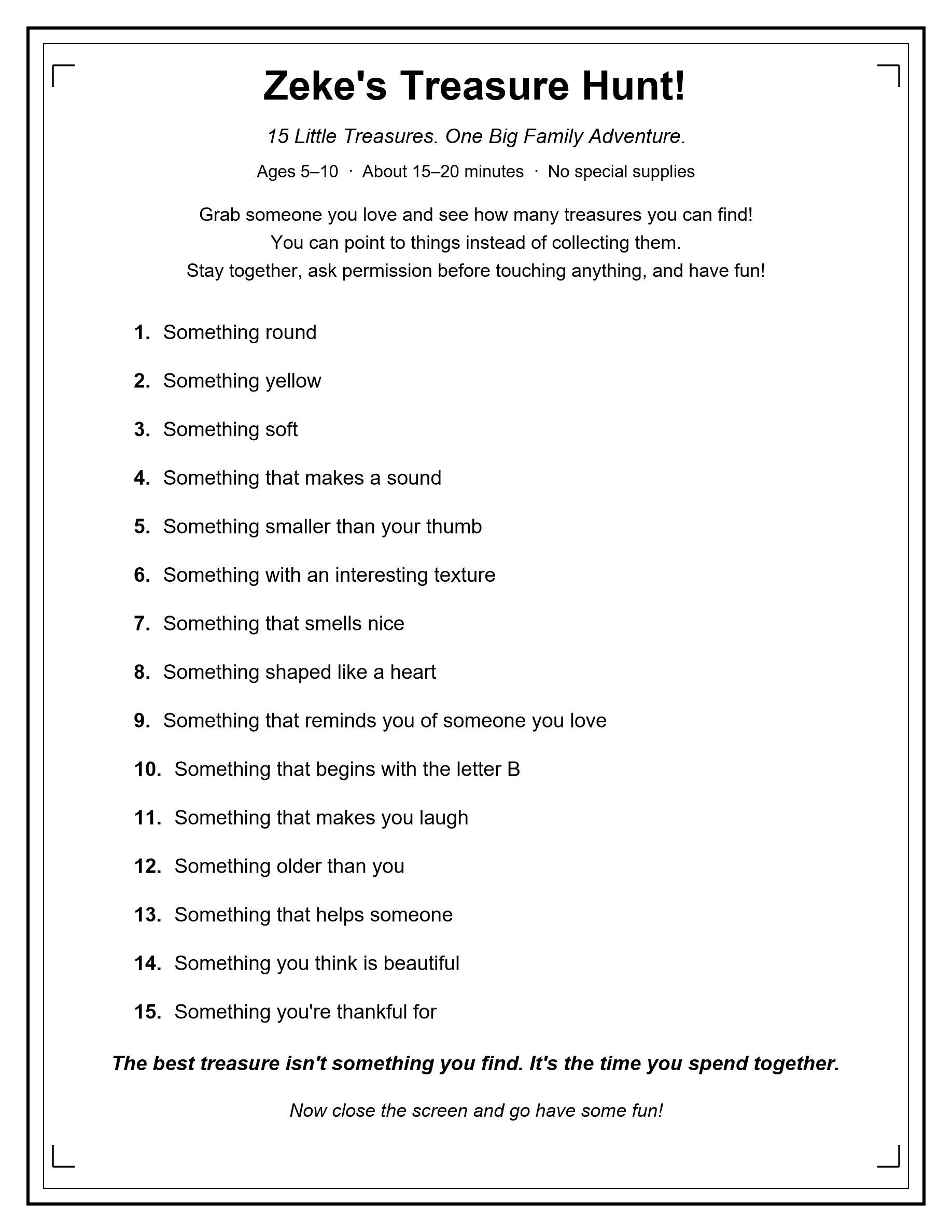
The best treasure isn't something you find. It's the time you spend together.
Now close the screen and go have some fun!
One letter-size page. No special supplies. Pick the maze that fits.
Help Zeke find his way back to Grandpa Harlan's porch. Follow the paths, but don't cross the walls!
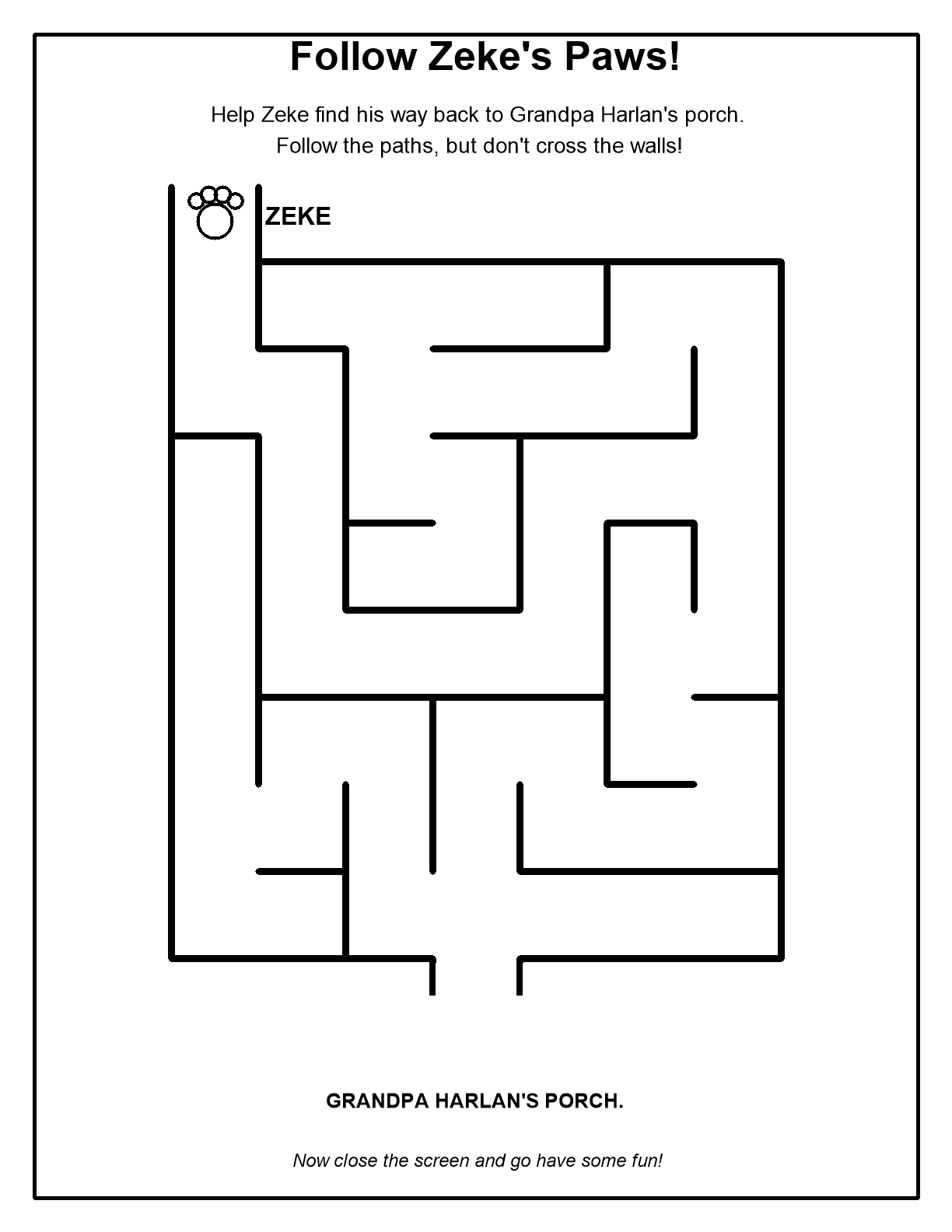
Zeke has wandered farther than ever! Help him find his way back to Grandpa Harlan's porch. Watch out for wrong turns!

Now close the screen and go have some fun!
About 10 minutes. Find a little open space. No equipment needed.
One person is the caller. Everyone else plays. Do the action only when the caller starts with “Zeke says.” If those words are left out, stay still and smile. There is no score. Switch callers whenever you like.
Add your own kind actions. Keep them easy for everyone in the family.
Now close the screen and go have some fun!
About 5 minutes. Read these out loud. Let everyone guess the riddle before you share the answer.
Riddle: I have no watch, but I know when someone I love comes home. I have no boots, but I wear four white socks. Who am I?
Answer: Zeke.
Now close the screen and go have some fun!